

Comfort and visual clarity are your top priorities at the time of choosing between spheric vs aspheric contact lenses.
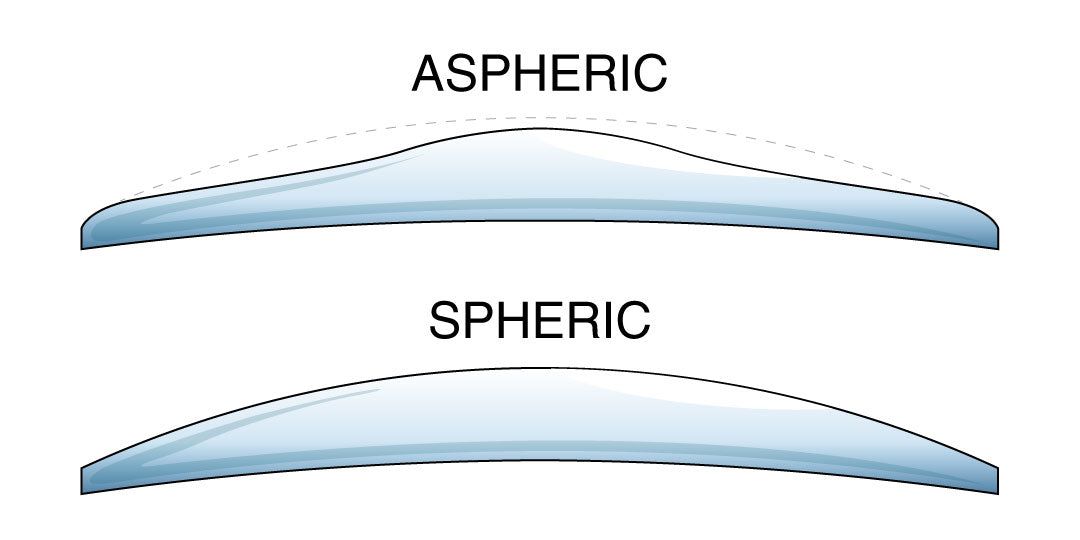
The debate between these two lens types often centers on how their design affects your daily wearing experience. Spherical contact lenses are shaped like part of a sphere, with the same curvature throughout the refracting portion of the lens. Aspheric lenses have a more complex shape where the curve changes from the center to the edge.
This difference in design can substantially affect your vision quality, especially in varying lighting conditions and to meet specific vision needs.
In this piece, we'll break down the comfort factors and visual performance to help you determine which lens type best suits your lifestyle and eye care requirements.
What Are Spheric and Aspheric Contact Lenses?
Spherical Contact Lenses: Design and Structure
Spherical contact lenses feature a uniform curvature across their surface, resembling the shape of a baseball or beach ball. The base curvature value remains consistent at any point on the lens. This standardized design has made spherical lenses the most worn contact lens type for many years.
Manufacturers often include various amounts of spherical aberration by design when creating these lenses. But this uniform curve presents a limitation: not all light rays hitting the lens surface join at the same point afterward. The rays entering through the curved lens edge refract differently than those passing through the axis area. So your eye cannot focus all rays at once, and images appear blurred.
Aspheric Contact Lens Design and Curvature
Aspheric contact lenses showcase varying curvatures across their surface that include a flatter area. The curvature changes from the lens center toward the outer edges and creates a larger usable lens area. This design induces a level of aberration that is inversely equal to the amount of natural spherical aberration inherent in your eye.
The flattened edges change the lens's optical properties. Parts of your eye including the tear film and cornea can induce aberrations, which aspheric lenses work to minimize. The formable surface allows manufacturers to avoid or reduce aberrations that are unavoidable with spherical lenses.
Key Differences in Lens Shape
Beyond the structural variations, aspheric lenses offer greater flexibility compared to spherical designs. They can correct optical defects and provide sharper vision in dark conditions because light penetrates and meets at one focal point instead of multiple points. Aspheric surfaces perform better in severe ametropia cases since they provide more precise light guidance. This proves apparent in the marginal lens areas where light is directed to the focal point from those regions.
Comfort Comparison: Spheric vs Aspheric Lenses
How Spherical Aberration Affects Comfort
Spherical aberration occurs when light rays passing through the periphery of your cornea and lens focus at a different location than rays passing through the center. This creates blur and halos around lights. The effect becomes more pronounced if you have large pupils, especially when you have poor lighting and your pupils dilate to compensate for low light.
A global study found that contact lens wearers experience substantial discomfort: 39% reported halos, 46% complained of glare, and 41% noted blur or difficulty seeing fine details. These complaints often stem from uncorrected higher-order aberrations. Spherical aberration is the largest.
Visual Clarity and Eye Strain Reduction
Aspheric lenses reduce eye tiredness from prolonged device use. Studies demonstrate that aspheric optics improve low-contrast and mesopic acuity while decreasing glare. Patients with higher refractive errors benefit most from aspheric designs, especially hyperopic prescriptions. Traditional bi-spherical soft contact lenses induce greater amounts of spherical aberrations.
Many wearers notice a difference in eye fatigue after extended screen time when switching to aspheric lenses. The improved visual acuity results in less eye strain throughout the workday.
Fit and Adaptation Period
Some wearers need time to adjust to aspheric lenses. The optics differ from traditional spherical designs. The brain may require an adjustment period to process the new visual input. Most adaptation issues improve with continued wear. Some individuals notice peripheral distortion during early use, especially when lenses are not centered correctly.
Performance in Different Lighting Conditions
Aspheric lenses preserve contrast sensitivity better than spherical lenses in less-than-ideal lighting conditions. Both glare and mesopic conditions reduce contrast sensitivity compared to normal lighting. Mesopic conditions cause a sharper drop due to pupil dilation. This dilation increases aberrations and causes flare when contact lenses are worn.
Who Should Choose Each Lens Type?
Best Candidates for Spheric Lenses
Spherical lenses work well as children's first prescriptions due to easy adaptation. They're suitable as backup glasses, reading glasses with prescriptions under +2.50, and budget-conscious purchases requiring quick turnaround. Spherical designs provide adequate vision if you wear contacts less than 4 hours each day.
People with prescriptions between +3 and -6 are unlikely to see any improvement from aspheric lenses. Aspheric lenses on these prescriptions may even lead to over-correction of spherical aberration and worsening of visual acuity.
When Aspheric Lenses Offer Better Comfort
Night driving creates demanding visual conditions. Aspheric lenses reduce optical errors in these situations. People working in low-lit offices or viewing screens in darker environments see improved contrast and sharpness.
High refractive errors around +4.00 diopters or higher respond well to aspheric designs. High myopia corrections exceeding -6.00 diopters and daily wear exceeding 8 hours favor aspherical options. Professionals requiring sharp peripheral vision, such as pilots and surgeons, see performance improvements.
Patients with mild glaucoma, early macular changes, or mild dry eye see benefits since aspheric lenses preserve remaining contrast sensitivity.
Special Considerations for Presbyopia and Cataracts
Multifocal contact lenses with aspheric designs correct presbyopia effectively. Aspheric multifocal lenses generate bifocal correction up to +2.50 diopters of add power and maintain excellent distance visual acuity.
Cataracts cause blurry vision that spheric lenses can worsen. Aspheric contact lenses reduce spherical aberration, which cataracts often intensify.
Contact Lens Options for Astigmatism
Astigmatism requires toric contact lenses with different prescriptions in each meridian. Soft toric lenses work well with mild astigmatism. Rigid gas permeable lenses often provide sharper vision in severe cases. Aspheric lenses can correct low astigmatism up to -0.75 or address presbyopia.
Types and Features of Aspheric Contact Lenses
Soft vs Gas-Permeable Aspheric Contacts
Soft aspheric lenses conform to your eye's shape and provide immediate comfort with shorter adaptation periods. You can get them with UV protection and colored options, which makes them versatile to meet different needs. But vision may not be as sharp compared to rigid alternatives if you have certain prescriptions.
Gas permeable aspheric lenses deliver superior oxygen transmission and sharper vision because they maintain their shape on your eye. The silicone-containing materials are more permeable to oxygen than many soft lens materials. GP lenses provide more stable astigmatism correction besides their optical advantages. The adaptation period takes a few weeks, though many wearers find GP lenses more comfortable than soft lenses after their eyes adapt.
Concentric vs Aspheric Multifocal Contact Lenses
Concentric multifocal lenses contain the distance power in the center. Concentric rings of near and distance powers surround it. At least two concentric power rings sit within your pupil area in normal lighting.
Aspheric multifocal contacts feature a gradual power change from far to near, like progressive eyeglass lenses. This creates a more natural visual experience and reduces halos or glare.
Daily, Weekly, and Monthly Replacement Options
Aspheric lenses come in multiple replacement schedules. Monthly options like Biofinity feature aspheric optics with over 240,000 unique prescriptions. Bi-weekly lenses such as Avaira Vitality incorporate the same aberration-neutralizing technology. Daily disposables including MyDay and clariti 1 day offer aspheric optics with UV blocking.
Comparison Table
Comparison Table: Spheric vs Aspheric Contact Lenses
| Attribute | Spheric Contact Lenses | Aspheric Contact Lenses |
|---|---|---|
| Design Structure | The surface has uniform curvature throughout, like a baseball or beach ball | The surface has varying curvatures with a flatter area; the curve changes from center to edge |
| Base Curvature | The value stays consistent at any point on the lens | Changes from the lens center toward outer edges |
| Light Focus | Light rays don't meet at the same point; rays through the edge refract differently than those through the axis | Light penetrates and meets at one focal point rather than multiple points |
| Spherical Aberration | Contains various amounts of spherical aberration by design and cannot focus all rays at once | Induces aberration that equals the natural eye aberration inversely; this reduces spherical aberration |
| Visual Clarity | Images appear blurred because all rays cannot focus at once | Vision becomes sharper, especially in dark conditions, and optical defects get corrected |
| Contrast Sensitivity | Performance drops in less-than-ideal lighting | Contrast sensitivity stays better preserved in poor lighting conditions |
| Eye Strain | Not mentioned for reduction | Eye tiredness from prolonged device use gets reduced |
| Glare and Halos | Wearers report halos 39% of the time and complain of glare 46% of the time | Low-contrast and mesopic acuity improve while glare decreases |
| Adaptation Period | Adaptation comes easy, especially for children's first prescriptions | An adjustment period may be needed; some notice peripheral distortion during early use if the lens isn't centered properly |
| Best for Prescription Range | Works well for prescriptions between +3 and -6 diopters | Works best for high refractive errors (+4.00 or higher, or myopia beyond -6.00 diopters) |
| Daily Wear Duration | Works fine for less than 4 hours daily | Better suited for daily wear beyond 8 hours |
| Performance in Low Light | Performance drops; mesopic conditions cause a sharper drop in contrast sensitivity | Performance stays better for night driving and low-lit environments |
| Best Candidates | Children's first prescriptions, backup glasses, reading glasses under +2.50, budget-conscious purchases, wear under 4 hours daily | Night drivers, professionals needing sharp peripheral vision (pilots and surgeons), high refractive errors, daily wear over 8 hours, patients with mild glaucoma or early macular changes |
| Presbyopia Correction | Not mentioned | Multifocal aspheric designs correct presbyopia up to +2.50 diopters of add power |
| Cataract Patients | Blurry vision from cataracts can worsen | Spherical aberration that cataracts intensify gets reduced |
| Low Astigmatism Correction | Not mentioned | Low astigmatism up to -0.75 can be corrected |
| Peripheral Vision | Light guidance becomes less precise in marginal lens areas | Light guidance in marginal lens areas stays better; peripheral vision becomes sharper |
Conclusion
The spheric vs aspheric debate doesn't have a universal winner. Your prescription strength and lifestyle determine the better choice. Spherical lenses work well for prescriptions between +3 and -6 diopters and short wearing periods. Aspheric lenses excel for high prescriptions, daily wear beyond 8 hours, and low-light environments. Night drivers and screen workers benefit from aspheric designs. Budget-conscious buyers or occasional wearers can stick with spherical options without compromising comfort. Ask your eye care professional to match lens type with your specific vision needs.