


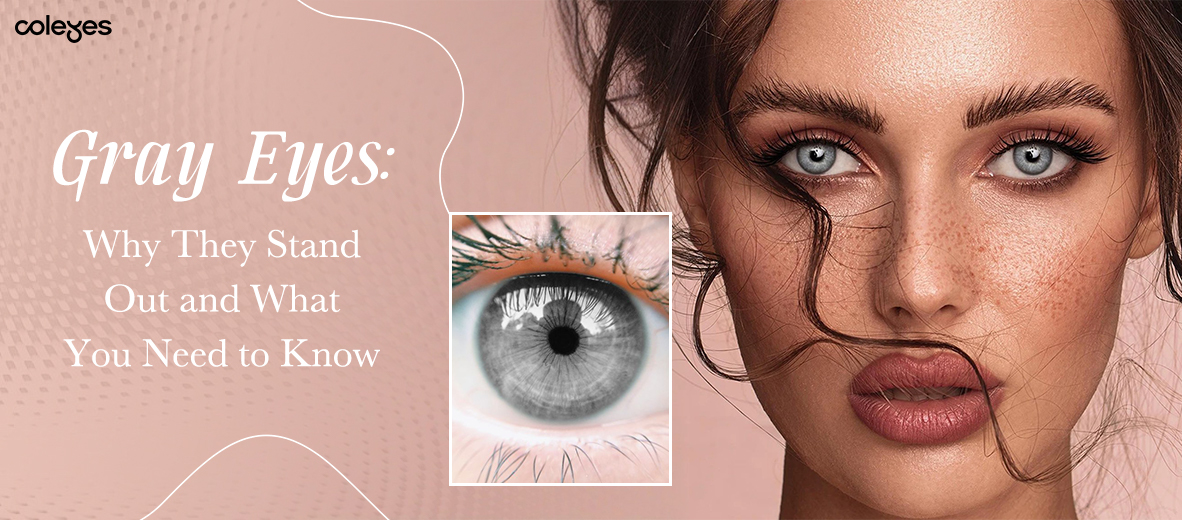
How rare are gray-blue eyes? They are rarer than you might expect, with estimates suggesting they occur in less than 1% of the global population. Gray eyes alone appear in roughly 3% of people worldwide, but broader blue or gray eye-color statistics often group gray-blue hues into those categories. Low melanin and light scattering, along with genes such as OCA2 and HERC2, shape your distinct grayish eyes. This piece explains the numbers, the mechanisms behind grayish eyes, and how to identify your true shade.
How Rare Are Gray Blue Eyes? What the Numbers Really Tell Us
Pinning down an exact percentage of people with gray-blue eyes is harder than it sounds because large-scale studies rarely track this shade separately. If you ask how rare gray-blue eyes are, the honest answer is that most sources rely on limited data and broad estimates rather than a global census.
Why commonly cited rarity figures require caution
Numbers vary widely by source. Some estimates suggest that fewer than 1% of people in the U.S. have gray eyes, while other online sources place the global figure closer to 3%. Large-scale research has not confirmed either figure, so they offer rough context rather than firm facts.
Eye-color classifications create part of the confusion. Experts do not always agree on which shades count as "main" colors. Some classification scales leave out gray eyes, while others distinguish them from blue. Every iris also contains a mix of tones instead of one flat color, so matching your eyes to a chart is rarely straightforward.
Why studies may group gray-blue eyes with blue eyes
Studies often place gray and blue eyes in the same category. A 2014 American Academy of Ophthalmology survey of the U.S. population, for example, reported 45% brown, 27% blue, 18% hazel, 9% green, and 1% for all other shades combined. It did not include a separate category for gray eyes.
A 2016 nationwide analysis of more than 235 million driver's-license records did track gray eye color separately. It found gray eyes in only 0.7% of license holders, compared with 23.7% for blue eyes, 10.3% for hazel eyes, and 9% for green eyes. This difference shows why gray-blue eyes often disappear into broader blue-eye statistics instead of being counted separately.
How eye-color rates vary by region
Eye-color distribution changes noticeably by location, and the driver's-license data illustrates this clearly. The table below shows several states with notable variation:
| State | Gray | Blue | Green | Hazel | Brown/Black |
|---|---|---|---|---|---|
| Maine | 0.5% | 37.7% | 8.3% | 18.5% | 34.9% |
| Wyoming | 0.6% | 35.6% | 12.7% | 16.8% | 34.3% |
| South Dakota | 0.6% | 38.0% | 12.0% | 14.2% | 35.2% |
| California | 0.6% | 15.3% | 7.0% | 7.5% | 61.0% |
Blue was the most common iris color in the first three states, likely because of migration history and a larger share of people with European ancestry. Globally, gray eyes appear more often in parts of Central and South Asia, as well as the Middle East. They also occur among Algeria's Shawia people in Northwest Africa. Blue eyes are more concentrated in Northern and Eastern Europe near the Baltic Sea.
Overall, the likelihood of having gray-blue eyes depends heavily on ancestry and geography, not chance alone. A figure from a U.S. survey may not apply to someone in Scandinavia or South Asia. Rarity percentages deserve caution rather than being treated as fixed global facts. For a broader look at grey eyes, including their common shades and characteristics, explore the related guide.
How to Tell Whether Your Eyes Are Gray Blue
Figuring out whether your eyes are truly gray-blue takes more than a quick look in the mirror. Lighting, cameras, and even your shirt's color can affect what you see, so a careful check helps.
Check your iris in soft daylight without photo filters
Stand near a window with indirect daylight, wear something neutral, and take a close-up photo of one eye. Remove colored contact lenses first, and avoid yellow indoor lighting, flash, or both because they can distort your iris's true shade. Cameras often make eyes look bluer than they are. Auto white balance cools indoor photos, sky reflections can tint a pale iris, and image compression can turn gray's subtle texture into an even bluish shade. Your eyes may be gray rather than blue if they look like a different "blue" in every photo, sometimes steely and sometimes bright. Gray irises can also contain subtle brown or golden flecks.
Tell gray-blue apart from pure blue
Use a clear photo with good lighting, then check the following:
- Hue test: Does a distinct blue tint run from the pupil to the rim? That suggests blue. A silver, smoky, or steel appearance without a clear hue suggests gray.
- Saturation test: Blue retains its color as the light fades, but gray becomes colorless sooner.
- Borrowing test: Do your eyes seem to take on your sweater's color or reflect the sky's mood? That reflectivity often points to gray.
Blue eyes usually have a vivid sapphire or ocean-blue tone. Gray eyes have a smoky look without that deep blue hue. The main difference comes from the iris's structure rather than melanin levels. Blue eyes have finer stromal fibers, while gray eyes contain denser collagen that scatters light more evenly. This often creates a smoother, mistier surface instead of the visible spokes and sunbursts common in a blue iris.
Identify dark gray-blue and gray-blue-green shades
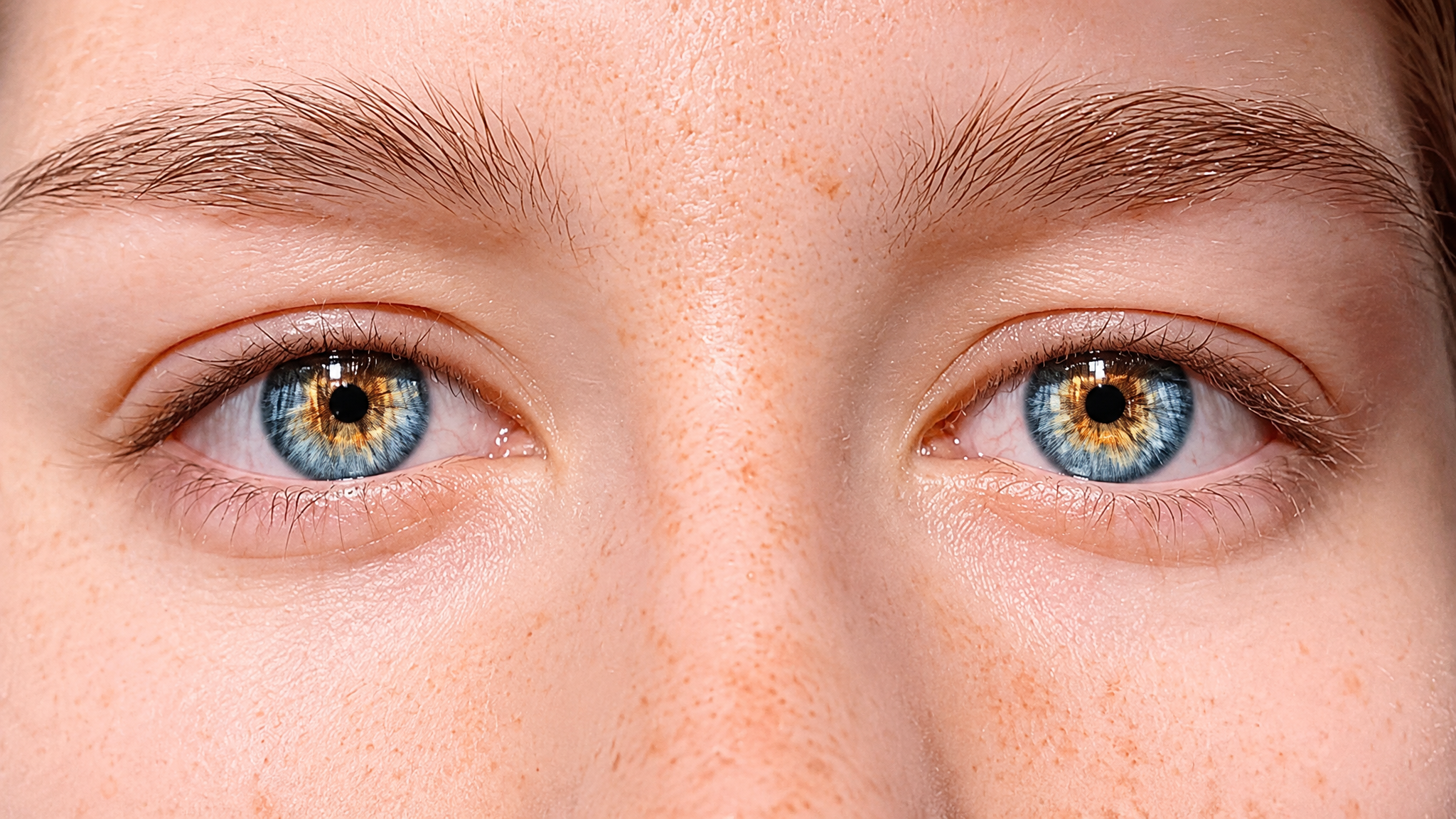
Dark gray eyes contain slightly more melanin than pale gray eyes. Compared with darker eye colors, their lighter appearance reflects differences in iris pigmentation. They can look charcoal or deep slate and may appear almost black in certain light. Blue-gray eyes can range from a delicate icy shade to a deeper blue. Slate gray, often called gray-blue, sits between the two colors. Its stroma is slightly less dense than pure gray, so it can look blue in bright light and return to a steely gray indoors. This shade appears often among Scandinavian and Baltic populations. A rarer variation, moss gray or gray-blue-green, combines a dense gray stroma with a tiny amount of yellow lipochrome. The result is a muted green-gray tint that usually appears near the iris's outer edge.
Why eye color labels are not always clear-cut
Eye color exists on a spectrum rather than as a simple switch. A pixel-level photo saturation analysis may produce a blue-gray percentage mix instead of one clear label. Many irises also have central heterochromia, which creates a golden or amber ring near the pupil that differs from the outer color. This is a normal variation, not a cause for concern. Color perception can also vary because people have different numbers of cone cells in their eyes. Older classification charts grouped gray with blue, but the first formal eye color scale from 1843 treated them as separate categories.
Why Some People Have Gray Blue Eyes
The science behind gray-blue eyes comes down to pigment levels and your iris's physical structure, not a special "gray" or "blue" dye inside the eye. The same pigment differences help distinguish Green eyes and Hazel eyes from gray-blue shades.
Low melanin and iris structure: no blue or gray pigment needed
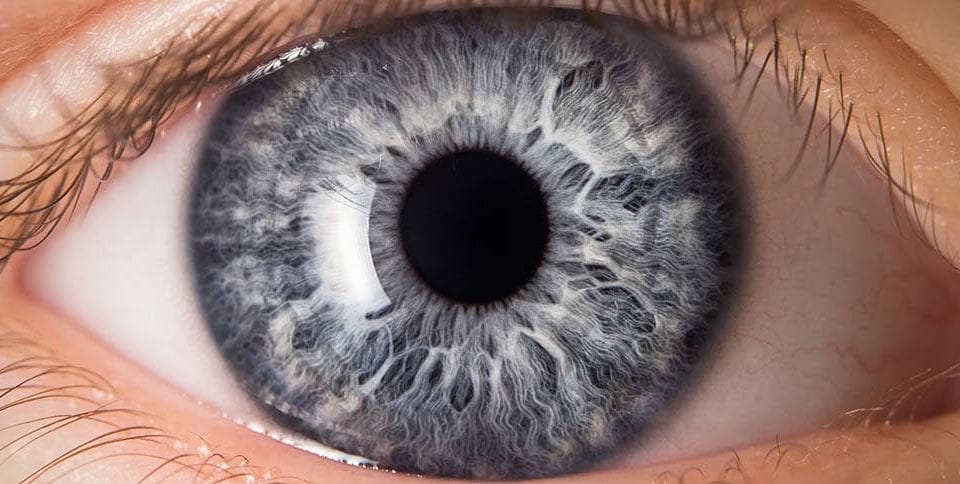
Most people are surprised to learn that neither blue nor gray pigment exists in the human iris. Melanin is the only pigment involved, and it appears in brown and black tones. Physics creates the color you see. Your iris contains a dark, melanin-rich layer at the back, called the pigment epithelium, and a clearer layer at the front, called the stroma. Light that hits the clear stroma sends shorter wavelengths back toward your eye through Rayleigh scattering. This is the same effect that makes the sky look blue and gives blue eyes their appearance.
Gray eyes rely on a related but distinct mechanism. Researchers think gray irises have larger collagen deposits in the stroma, which scatter light through Mie scattering instead. This process depends less on wavelength and shifts blue toward a smokier, neutral tone, like a clear sky that becomes gray and overcast after water droplets fill the air. Another theory suggests that gray and blue eyes differ only in the amount of melanin near the stroma's front. Either way, magnification often reveals small yellow and brown flecks woven through gray irises. Gray-blue-green shades can develop from a mix of eumelanin and pheomelanin. Eumelanin shapes the green undertone, while pheomelanin adds warmer flecks.
How OCA2, HERC2, and other genes influence eye color
A cluster of genes on chromosome 15 influences your eye color, with OCA2 and HERC2 playing major roles. OCA2 produces a protein that helps build melanosomes, which make and store melanin. Variants that reduce this protein allow less melanin to reach the iris. A nearby section of HERC2 works like a dimmer switch that controls whether OCA2 turns on or off. The SNP rs12913832 is the leading predictor of blue versus brown eyes. However, one study found that 43 of 166 Norwegians with the "expected brown" genotype did not have brown eyes. Researchers linked 86% of those cases to five newly identified variants that work with OCA2 and HERC2. Other genes, including ASIP, IRF4, SLC24A4, SLC24A5, SLC45A2, TPCN2, TYR, and TYRP1, also affect the final shade. Some researchers estimate that up to 16 genes may shape eye color overall, while one study linked ten genes to about half of all eye-color variation.
Do Gray Blue Eyes Change With Age or Mood?
Your gray-blue eyes may not remain completely fixed throughout life, though the reason for any color change depends heavily on your age and what is happening inside your iris.
Why babies' eye color may change over time
Newborns often have blue or gray irises because melanin has not built up yet, and the womb's dark environment also plays a role. Light exposure after birth prompts melanocytes to produce more pigment. Most changes occur between 3 and 9 months and often settle near the 6-month mark, though the final shade can take up to three years to develop. The Louisville Twin Study followed 1,513 twins and found that most people reach a stable eye color by age 6. Still, 10% to 15% of white participants continued to experience color changes through adolescence and adulthood. The NEST newborn study found green and hazel eyes in only 5.7% of babies at birth, while partial heterochromia appeared in just 0.5%.
Why mood does not directly change iris pigment
Your mood does not rearrange melanin. Strong emotions such as excitement or fear can dilate your pupils, which compresses the surrounding iris tissue and makes the pigment appear darker briefly. The iris's underlying color remains the same, but its appearance can change temporarily.
Medical care for a lasting or one-sided color change
A sudden or one-sided color change differs from normal patterns and needs attention. Fuchs heterochromic iridocyclitis, Horner's syndrome, pigment dispersion syndrome, ICE syndrome, eye trauma, and glaucoma medications such as latanoprost, bimatoprost, and travoprost can permanently alter iris color. A small percentage of Caucasian eyes may gradually lighten with age, while prolonged sun exposure may darken them slightly. Schedule an eye exam if either change appears suddenly.
Can You Get Gray Blue Eyes With Colored Contacts?
Wearing colored contacts offers the quickest way to get gray-blue eyes when your natural iris lacks that shade, but the final look depends heavily on your starting eye color.
How gray blue colored contacts look on light and dark eyes
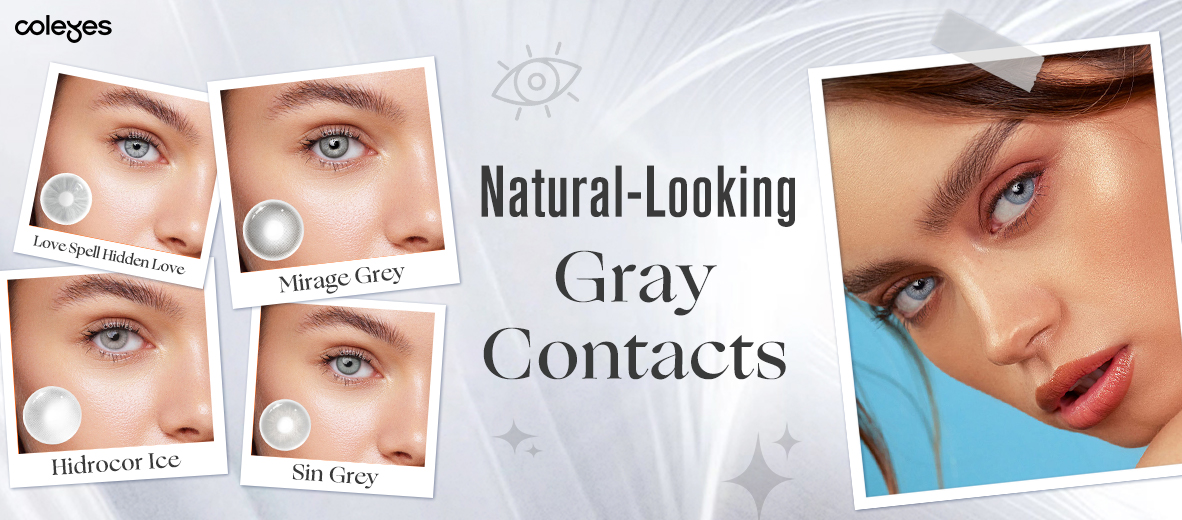
Gray eyes can be recreated with colored lenses. Gray lenses create a soft, smoky effect and often blend more naturally with dark eyes than blue lenses. Gray is closer to a neutral tone, so it does not clash as much with brown pigment. Blue lenses create a brighter, more noticeable change that stands out even in dim lighting, while Brown lenses offer another natural-looking option. Both shades need higher opacity to cover dark brown or black eyes completely, although gray usually needs less coverage to look natural.
Choosing subtle lenses or cosplay contacts
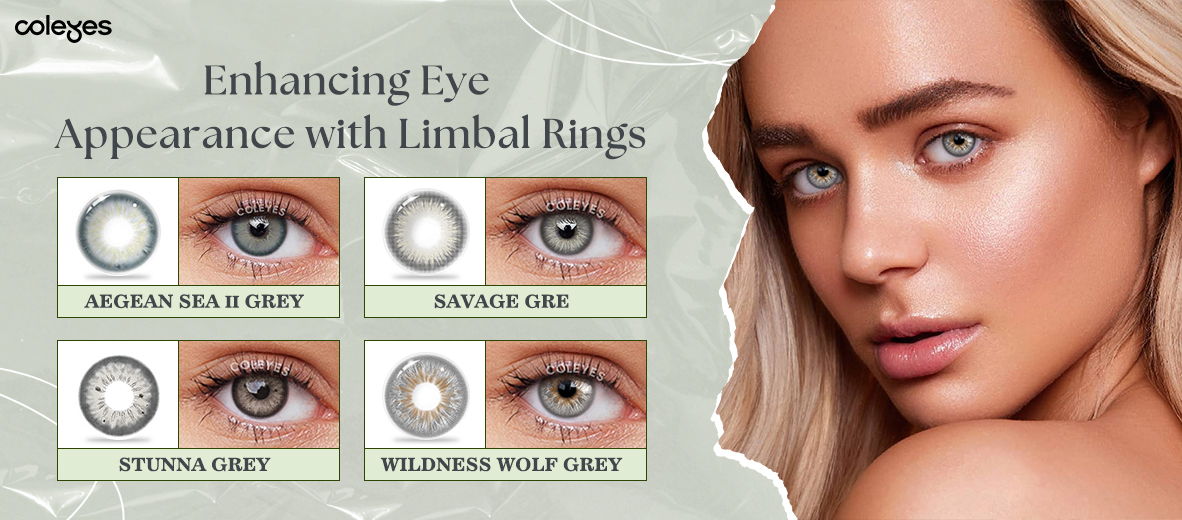
Choose lenses with soft gradients and gentle limbal rings for everyday wear instead of cosplay designs. Cosplay lenses often use bold patterns, enlarged iris effects, and larger diameters for dramatic character changes. Regular colored contacts use blended transitions and realistic iris textures, so gray-blue eyes can look like your natural eye color rather than part of a costume.
Why even nonprescription colored lenses need a proper fitting
Every tinted or clear lens is a regulated medical device that requires a prescription and professional fitting, whether or not you need vision correction. A Texas survey of 686 women found that 1 in 4 had worn non-prescription contacts. Sixty percent reported pain or irritation, including redness and swelling. That number rose to 88% among people who borrowed lenses. About 1 in 7 teens reported similar use and often stored lenses in plain water. An FDA review of 300 illegal lenses found bacteria in about 60% of them.
Safe lens care and why contacts do not replace UV protection
Lens wear during sleep raises infection risk six to eight times. Clean lenses with fresh solution, replace them on schedule, and never share them. Colored contacts only change your appearance and do not protect your eyes from the sun, so sunglasses are still necessary outdoors. For additional information about UV protection, choose sunglasses that block ultraviolet rays.
Conclusion
Gray-blue eyes are undeniably rare, with fewer than 1% of people worldwide having them. An exact figure remains difficult to establish because many studies group this shade with broader blue or gray categories.
Low melanin, collagen density, and genes such as OCA2 and HERC2 determine your eyes' true color rather than a special pigment. Your eye color may move subtly with age, mood, or lighting, and understanding what happens inside the iris can explain the science behind the shade. If you are thinking about colored contacts to achieve this look, gray-blue eyes remain a genuine genetic rarity worth appreciating.