


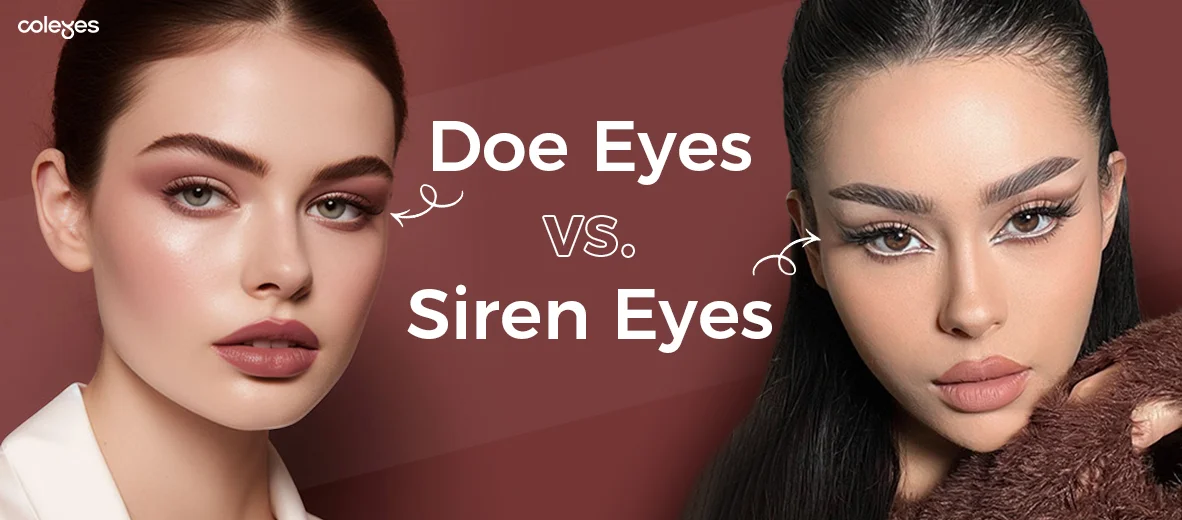
Siren Eyes vs Doe Eyes: What Is the Difference?
Before buying a single lens, you should understand what separates these two looks structurally. Doe eyes and siren eyes sit at opposite ends of the eye-shape spectrum, and recognizing each category's traits makes later contact lens choices easier.
Siren eyes meaning: A long, lifted look
A siren eye shape appears elongated and almond-like, with outer corners that narrow into a slight point and tilt upward instead of sitting level. A defined lid crease and lifted brow line create added depth, which gives the gaze an intense, slightly mysterious feel. Makeup creates siren eyes by extending the wing outward instead of upward, darkening the outer corner, and sometimes lining the waterline for more drama. People with naturally almond-shaped eyes often have an advantage because their outer corners may already turn upward. They need less eyeliner to create the lifted, cat-like effect. The overall look feels confident and alluring, with attention drawn toward the eye's outer edge instead of the center.
Doe eyes explained: A round, open look
Doe eyes move in the opposite direction. This shape is rounder, with a prominent iris and little visible white space. The outer corners remain smooth and level or turn down slightly rather than lifting. The palpebral fissure, the technical term for the visible eye opening, is usually tall compared with its width in a doe eye. The limbal ring around the iris also tends to remain visible all the way around, which makes the eyes appear larger and brighter. This combination feels soft, youthful, and approachable rather than striking. Research that compared the two styles found that doe eyes often score higher for warmth, approachability, and trustworthiness. The more angular, lifted look scores higher for confidence and intensity. Neither look is better. Each communicates something different, which is why many people switch between them based on their mood or the occasion.
Natural eye shape vs the effect of contacts and makeup
This point matters most when you start browsing lenses: doe eyes and siren eyes are not fixed anatomical categories. They are looks created through features such as eyelid position, iris visibility, lash placement, and surrounding facial structure. Most people have a blend of traits instead of fitting neatly into one category. Siren eyes are often considered a makeup style rather than a formal eye shape, though people with naturally upturned corners may still be called siren-eyed informally. Contacts play a specific role in this look. A colored lens cannot physically reshape your eye or change the angle of its outer corner. It can change the iris's appearance through color, contrast against the sclera, or a defined limbal ring that makes the colored part of the eye stand out. This difference explains why lens selection and makeup technique work as separate tools for creating doe eyes or siren eyes rather than replacing one another.
How to Pick Contacts for Doe Eyes
Choosing contacts for a doe-eye look means finding features that work together rather than separately: a defined limbal ring, a generous graphic diameter, and a soft color blend that still looks natural. Each detail affects how open and youthful your eyes appear, so understanding what each one does makes shopping nowhere near as much of a guessing game.
Defined limbal rings for a larger-looking iris
A limbal ring is the line between your iris and the white of your eye. A defined limbal ring appears as a darker, more noticeable outline around the colored area. Circle lenses use this feature on purpose. A bold ring, often printed in black or deep gray, makes the eyes look wider and more youthful. The effect takes inspiration from the distinct limbal rings people are often born with, which can fade over time.
Your brain reads the dark outer ring as the iris's true edge, making the colored area seem larger without changing the lens's actual size. A strong black ring can create a bigger effect than a larger lens with soft, faded edges alone. A visible, contrasted limbal ring should be high on your checklist if you want a doe-eye finish.
Graphic diameter and the strength of the enlarging effect
Graphic diameter, or GD, refers to the lens's printed colored area rather than its overall size. It is the main measurement that determines how large your eyes will look. A GD below 13.3 mm stays close to the average human iris, which measures about 12.8 mm across, so it looks natural rather than enlarged.
Lenses above 13.3 mm create a slightly bigger, wide-eyed look that can still work for everyday wear. The effect changes to a doll-like appearance beyond 13.7 mm, while anything over 14.0 mm enters anime-inspired or costume-ready territory. Many people choose a medium GD of about 12.9 mm to 13.5 mm for a wearable doe-eye effect. This range is popular in K-pop and ulzzang-inspired styles because it makes the eyes look noticeably wider without looking like cosplay.
Soft color blends for a natural doe-eye look
Doe eyes look soft and open, so color blending matters as much as size. Choose lenses with soft gradients, two- or three-tone designs, or gently blended limbal rings instead of one flat color. Semi-opaque lenses allow some of your natural eye color to show through and create a softer result. Opaque lenses offer stronger coverage when you have darker eyes and want the new shade to stand out clearly.
Gray lenses often look more believable with a darker outer ring instead of a pale, flat shade. Hazel and olive colors combine warm and cool tones, and they adapt well to different lighting. Brands such as Solotica offer collections like Hidrocor without limbal rings for a soft, natural finish in twelve shades.
How to Pick Contacts for Siren Eyes
Siren eyes depend more on makeup technique than on the lens itself, so contacts should support the look rather than take center stage.
Subtle iris borders that keep the focus on eye makeup
Winged liner, smoked outer corners, and strategic lash placement create the elongated siren effect. Colored contacts only add contrast or change the iris color without altering the eye's actual shape. A heavy, clearly defined limbal ring can draw attention away from the makeup that creates the elongated look.
Lenses with no limbal ring or only a soft one keep the iris close to its natural appearance. This lets the liner and shadow stay in focus. Strong contrast around the iris can look "obviously colored" in photos, so a softer edge works better if eyeliner should carry the look instead of the lens.
Color contrast for a bold gaze
After choosing the border, color becomes the next decision. Brown eyes work with nearly every shade, and bold siren styles often use cool contrast, such as blue or icy tones. Green eyes can look intense with color quickly. Ice blue or violet can create a stronger contrast, while hazel eyes' natural mix of tones makes gradient lenses look believable even with more contrast.
Opacity determines whether the color will show on darker irises. Deep brown or black eyes need a more opaque lens to make the color stand out, while lower-opacity lenses create a softer change. Deep sapphire and blue-gray shades provide clear contrast but blend more naturally with dark features than very light blue.
Fine iris patterns for a softer siren look
A bold shade does not need to look flat. Natural irises contain several tones, so lenses with two or three colors, fine radial lines, or a soft brown transition near the pupil create depth that a single-color lens cannot match. Tri-tone designs, especially collections with a brown inner ring, help a bright outer shade blend more naturally with a dark iris.
A detailed iris pattern can make a dramatic shade, such as emerald or violet, appear intentional rather than costume-like. This keeps the siren gaze sharp instead of artificial.
Why darker contacts are not always the best choice
Eyeliner and lash placement create most of the elongated siren effect, so the darkest or most opaque lens is not required to achieve the look. A heavily pigmented design with a flat color can still appear artificial despite its strong payoff. Smoky gray and muted olive shades often look more natural than silver, icy gray, or neon tones, which can make the result feel dramatic or costume-like.
A shade with depth and subtle transitions usually works better than one selected only for its darkness if a believable finish matters more than maximum effect.
How to Pair Your Contacts With Eye Makeup
Once you choose your lenses, the makeup you apply determines whether the final look feels doe-eyed or siren-eyed. The same contacts can create either effect based on shadow placement, liner shape, and lash focus.
Doe eyes: Rounded shadow, bright lids, and center-focused lashes
Apply a light neutral shadow across the lid, then blend a slightly darker cool-toned shade through the crease. Keep the shape rounded instead of pulling it toward the temple. Tap a lighter shade onto the center of the lid to create the doll-like roundness that defines this style. Keep upper-lash liner thin without a sharp wing, then use a nude or white pencil on the lower waterline to make the eyes look more open. Finish with mascara on the center lashes, and curl them well before applying it. This placement rounds the eye shape rather than elongating it.
Siren eyes: Outward shadow, thin wings, and outer lashes
Siren makeup takes the opposite direction. Apply deeper eyeshadow along the outer lash line and outer third of the lid, then blend it outward rather than upward to maintain an elongated shape. Keep liner thin through the center, and taper a wing from the outer corner. Avoid adding thickness directly above the pupil because it can make the eye appear smaller. Apply extra mascara or half lashes at the outer edge to strengthen the lifted, horizontal effect.
Placement tips for hooded, round, and downturned eyes
Your natural eye shape affects where each technique works best:
- Hooded eyes: Keep liner thin and place crease shadow slightly above the natural crease so it remains visible with open eyes. This approach works for both doe eyes and siren wings.
- Round eyes: Keep the center lighter for doe eyes without overdoing the roundness. Focus on longer wings and outward-blended shadow to create siren eyes.
- Downturned eyes: Use matte shadow to lift the outer corner instead of relying on a heavy wing. Angle liner upward rather than following the eye's natural downward slope.
Switching between both looks with the same contacts
Contacts change iris color and contrast, not bone structure, so one pair can work with either look. Change the shadow direction, liner shape, and lash placement, and a similar lens can look soft and round one day or elongated and intense the next.
How to Buy and Wear Colored Contacts Safely
The styling choices above matter only when your lenses are safe to wear, and safety begins long before you choose a shade.
Get an eye exam and prescription, even for cosmetic lenses
Every colored contact lens, including plano designs that do not correct vision, is a medical device under FDA rules. The law requires a prescription whether the lens changes your look or corrects your sight. A valid prescription includes the brand name, lens measurements, and expiration date.
Let an eye care professional set the fit and lens size
An eye doctor measures your eye's curvature and diameter during a fitting. The doctor also checks how the lens moves before approving it. Base curve and hydration affect how a lens fits, so costume and cosmetic lenses need the same careful fitting as corrective lenses.
Buy from a seller that checks your prescription
Buy lenses only from sellers that require your prescription, whether you shop in person or online. Skipping this step increases the chance of receiving uncleared or counterfeit lenses.
Wash hands and insert contacts before makeup
Wash and dry your hands, then insert your lenses before applying makeup. Remove your lenses before taking off makeup at night to keep remover away from your eyes.
Follow the lens care schedule and avoid water, sleep, and sharing
A few rules help protect your eyes over time:
- Rub and rinse lenses with fresh solution each time, even with "no-rub" formulas.
- Replace the lens case every three months.
- Never rinse lenses with tap water because it can carry Acanthamoeba.
- Avoid sleeping in lenses unless your doctor approves overnight wear.
- Never share lenses with anyone.
Remove lenses and seek care for pain, redness, or blurred vision
Remove your lenses immediately and call your eye doctor if you notice redness, pain, discharge, or blurred vision. These symptoms may indicate keratitis, a corneal infection that can cause lasting vision loss if left untreated.
Conclusion
Doe eyes and siren eyes come down to technique rather than anatomy, so your natural eye shape does not limit either look. Limbal ring strength and graphic diameter, along with color depth, shape the contact lens effect, while shadow direction and liner shape influence the makeup, as does lash placement. Both elements work together instead of separately, so one well-chosen lens pair can move from soft and round to lifted and intense with a few styling changes. A proper prescription and safe wear habits protect your eyes before styling matters. Get a proper fitting and follow care guidelines so you can switch between looks with confidence.