

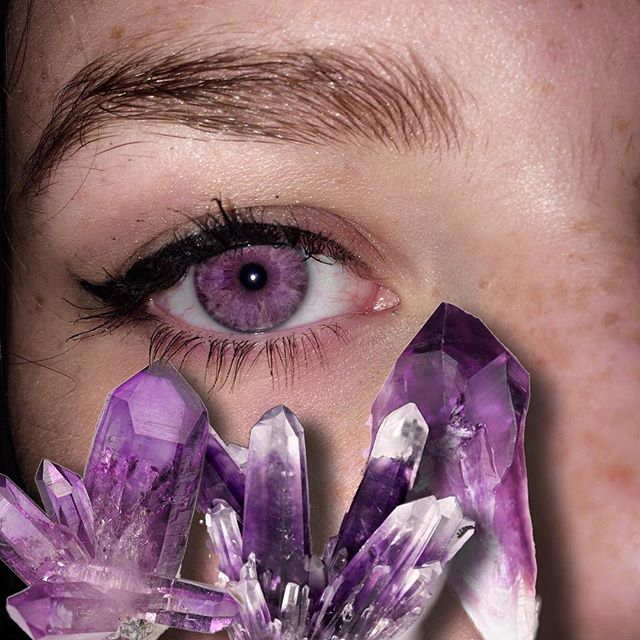
A natural violet eye may sound mythical, but science says otherwise. Fewer than 1% of the global population may have this rare hue. But true purple eyes rarely result from pigment alone. Low melanin levels and light scattering instead create the appearance of violet eye color. You may ask whether purple eye color is genetic, linked to albinism, or simply caused by lighting. This piece separates fact from fiction and explains how you can recreate the look safely with purple eye contacts.
Are Natural Violet Eyes Real?
Violet eyes are a visible phenomenon, but the science behind them is more complex than most rare-eye-color lists suggest. The iris does not contain a purple pigment in the way it contains brown-toned melanin. Calling a violet iris "pigmented purple" misses what happens within the tissue.
Violet-looking eyes versus true purple pigment
Most casual discussions of natural violet eyes miss this key difference: the color you see does not prove that a separate biological substance exists. Blue eyes do not look blue because they contain blue dye, and a violet eye color does not need purple dye either. Light interacts with melanin and the iris's physical structure to create the effect.
Violet is considered a rare form of blue eyes. A specific iris structure scatters light around melanin pigment in a way that creates the violet appearance. Without that structure, the eyes may look blue, gray, or lavender rather than deeply violet.
Purple eyes and related terms, such as lavender and lilac, describe a range of visual effects rather than a single pigment type:
| Appearance | What's Really Happening |
|---|---|
| Violet eyes | Cool blue with a clear purple cast |
| Lavender/lilac eyes | Pale gray-blue with subtle pinkish-purple undertones |
| Purple eyes | A broad, vivid purple appearance, often caused by edited photos or lenses |
| Blue eyes | Bright cool blue caused by low melanin and light scattering |
When someone says their eyes have an amethyst colored eyes quality, they are describing how they look rather than reporting a lab-confirmed pigment result. This clarification matters when considering whether purple eye color is genetic or an effect of optics and lighting. The next sections explain that question in more detail.
Why there is no reliable count of people with purple eyes
Anyone searching for the exact number of people with purple eyes has likely found very different estimates. Some sources claim that fewer than 1% of the global population has this rare hue. Other sources repeat that figure but acknowledge that large-scale eye-color studies are limited, so the percentage is an estimate rather than a confirmed statistic.
Several reasons make a dependable global count difficult:
- Inconsistent labeling – One person may describe an iris as pale blue, while another may call the same eye lavender.
- Lighting variation – An eye can look very different in daylight and in a portrait studio.
- Broad survey categories – Most population studies place unusual cool shades under "blue" or "gray" instead of tracking violet separately.
- Selection bias – Striking images spread more widely than standardized photos of ordinary eyes, which can make the look seem more common than it is.
- No pigment-based diagnostic criterion – "violet" is a visual description, not a laboratory-measured subtype.
These differences make it more accurate to say that convincing violet-looking eyes are uncommon instead of assigning them a precise percentage. Green eyes occur in about 2% of the global population, while red and violet appearances occur almost only alongside albinism, which makes them rarer. The link between albinism and eye pigmentation needs further explanation because it accounts for much of what creates a genuine red violet eye color natural appearance.
What Makes Eyes Look Violet?
Color in the iris results from biology and physics, and violet eye color becomes less mysterious once you look at both. The iris contains several layers, including the anterior border layer, stroma, pigment-bearing cells, collagen, blood vessels, and a heavily pigmented back surface. Light that hits these structures is absorbed or scattered before an observer sees it.
How melanin and light scattering shape eye color
Melanin exists in two functional forms within the iris. Eumelanin creates deep brown tones, while pheomelanin contributes to amber, green, and hazel shades in lighter irises. Blue eyes develop when the stroma contains little melanin. The dark pigment epithelium beneath it absorbs longer wavelengths, while shorter blue wavelengths scatter back through Rayleigh scattering, the same effect that makes the sky appear blue. Gray eyes form differently. Larger collagen deposits in the stroma produce Mie scattering, which does not favor one wavelength as Rayleigh scattering does. A true violet eye color needs a specific iris structure that creates a particular scattering effect around the remaining melanin pigment. Typical blue or gray eyes do not reproduce this effect. Pigment amount and distribution both matter, so no single measurement can define a person's exact iris composition.
How genes influence iris pigment
Genetics determines how much melanin develops in the iris. Researchers have linked up to 16 genes to eye-color inheritance, although more focused research identifies eight genes with major effects. These genes are part of more than 150 known to influence skin, hair, and eye pigmentation. OCA2 and HERC2, located on chromosome 15, have the strongest influence. OCA2 produces the P protein, which supports melanosome maturation. A regulatory region in HERC2, called intron 86, controls OCA2 activity. Even people with two copies of the blue-associated OCA2 allele develop blue eyes only 62% of the time. Meanwhile, 7.5% of people with brown-associated alleles still have blue eyes, which shows that other genes also contribute. A 2010 study identified ten relevant genes that explained about half of all eye-color variation. A later genome-wide study of nearly 195,000 people found 50 additional loci linked to pigmentation and iris structure. No gene serves as a diagnostic marker for violet eye color, and a simple inheritance chart cannot predict a child's final eye shade.
Why lighting and nearby colors can change what you see
Color perception varies with the light that reaches the eye and the brain's interpretation of it. Structural colors, such as blue and violet, change more noticeably under different lighting conditions than solid pigment colors like brown. Window light and warm bulbs, along with camera white balance, exposure settings, nearby clothing, or makeup, can make a pale blue iris appear lavender or violet in photos. Pupil size also affects what you see because a larger pupil reduces the visible iris area and changes the overall contrast. Stand near a window in neutral daylight and avoid colored lamps or flash to assess your eye color most accurately.
How Albinism Can Affect Violet Eye Color
Albinism provides the clearest biological explanation for a convincing violet appearance, and the mechanism deserves a closer look. This type of violet results from an almost complete lack of pigment, not from a specific iris structure or the light-scattering process described earlier.
How low pigment can create a reddish-violet appearance
Very low melanin levels in the iris allow light to pass through the tissue rather than absorb into it. The light reflects off blood vessels at the back of the eye and returns with a red tint. That reflection alone appears pink or red. A small amount of remaining melanin can add a faint blue tone, and the blue mixes with the red reflection to create a visible violet or lavender cast. True red violet eye color natural appearances in albinism therefore result from a combined effect rather than violet pigment on its own.
Why not everyone with albinism has the same eye color
Albinism does not create one fixed eye color. Documented iris shades range from very light blue to hazel and brown, and color may change with age. Most people with albinism have blue eyes, while fewer have hazel or brown tones. The specific type of albinism affects this variation. Oculocutaneous albinism affects pigment in the skin, hair, and eyes, while ocular albinism mainly affects the eyes and may still allow brown irises depending on the subtype. Albinism affects an estimated 1 in 20,000 people overall, so a violet appearance remains a less common outcome within that group rather than the default.
How albinism can affect vision and light sensitivity
Reduced pigment changes more than eye color. It can interfere with retinal development and optic nerve wiring, so vision problems define the diagnosis far more than iris color. Common findings include nystagmus, or involuntary eye movement, along with strabismus, astigmatism, photophobia, and reduced visual acuity caused by underdeveloped retinal structures. One clinical study on photosensitivity found that 22.2% of participants had few or no problems, 40.8% had moderate problems, and 37.0% reported severe discomfort in bright light. These results show how much this symptom can vary between people.
Why eye color alone cannot confirm albinism
A violet or reddish tint may raise suspicion, but it cannot confirm albinism by itself. Diagnosis relies on clinical findings such as iris transillumination, retinal structure differences, and optic nerve connection patterns. Genetic testing or visual evoked potential exams often support the diagnosis. Eye color overlaps heavily with the general population, so a formal eye exam is the only reliable way to identify albinism.
Famous Violet Eyes and Common Myths
Elizabeth Taylor's eyes inspired one of pop culture's longest-running eye-color debates. Her story shows how lighting, cosmetics, and genetics can create a convincing violet appearance without true purple pigment.
Elizabeth Taylor's eyes: appearance versus proof
Fans and journalists have described Taylor's eyes over decades as blue velvet, dark denim, deep purple, or vivid violet. The debate became so persistent that she named a fragrance "Elizabeth Taylor Violet Eyes". Discussion continues on Reddit, TikTok, and Instagram, where users ask whether her eyes were truly violet or an intense blue shade. Snopes contacted House of Taylor, the company that manages her estate's archive, and a spokesperson confirmed that she never wore contacts or colored lenses. The spokesperson did not identify her exact natural eye color.
Her early black-and-white films helped create some of the mystique, as did later oversaturated Technicolor processing that gave publicity photos exaggerated color. Jewel-toned clothing and makeup in blue, green, and purple also enhanced the cool tones in her eyes. Classic Hollywood Central states that Cat on a Hot Tin Roof used color film in part to highlight her eyes beside co-star Paul Newman's blue eyes. Critic David Stratton said he was "transfixed" by her "famous violet eyes" at a 1973 premiere.
Ophthalmologist Dr. Norman Saffra told Live Science that her eye color likely resulted from a particular level of melanin. He noted that "it's possible to have that eye color; it all depends on the amount of melanin". The Optical Academy says true purple eyes occur in fewer than 1% of people worldwide and usually relate to albinism, a condition Taylor did not have. She did have distichiasis, a mutation that causes an extra row of eyelashes. That condition affected her lash line, not her iris pigment. Snopes rated the claim that Taylor naturally had violet eyes as "Unproven", and Classic Hollywood Central considers it "probably false".
Alexandria's Genesis: a fictional purple-eye condition
Online claims about "Alexandria's Genesis" are separate from Taylor's story. They describe a supposed mutation that turns people into flawless "perfect human beings" whose purple eyes appear about six months after birth. The claim appears throughout forums and social media posts, but documented genetics and recognized medical literature offer no support for it. Alexandria's Genesis is fictional, not a real explanation for natural violet eye color.
How to Get the Violet Eye Look Safely
Recreating this look depends on choosing the right type of lens and handling it as the medical device it is under law.
Purple eye contacts for light or dark eyes
Opaque violet contacts fully cover dark irises, while enhancement tints suit lighter eyes because they deepen the color already present instead of covering it. Brands state that heavily pigmented lenses can turn even very dark brown eyes a noticeable shade of purple.
Subtle violet shades and bold cosplay designs
Lilac and light lavender lenses blend with your natural eye color for everyday wear. Solid opaque violet or amethyst designs work well for cosplay and Halloween, where a dramatic change is the goal.
Proper fitting and a prescription, even without vision correction
The FDA classifies every colored lens, whether plano or corrective, as a medical device. An eye exam and prescription are required. Skipping this step increases the risk of serious problems. About 1 in 500 contact lens wearers develops a serious infection each year, and borrowed lenses raise that complication rate to 88%.
Water exposure and replacement schedules
Do not swim, shower, or sleep while wearing lenses. Replace your lens case every three months to prevent Acanthamoeba contamination.
Lens removal and care for pain, redness, or blurred vision
Remove your lenses at once and call your eye doctor if your eyes become red or painful or if your vision becomes blurred.
Conclusion
Natural violet eyes usually appear as a visual effect rather than a distinct pigment. Low melanin, light scattering, and, in some cases, albinism can create this appearance. Genuine cases are rare, and lighting and photography, along with cultural fascination surrounding figures such as Elizabeth Taylor, have made the hue seem more common than it is.
Purple contact lenses can create a striking violet look without relying on genetics. Users should treat them as medical devices, get an eye exam, follow replacement schedules, and watch for irritation. The science behind violet eyes highlights their rarity and helps you make safe, informed choices if you want to try the look.