

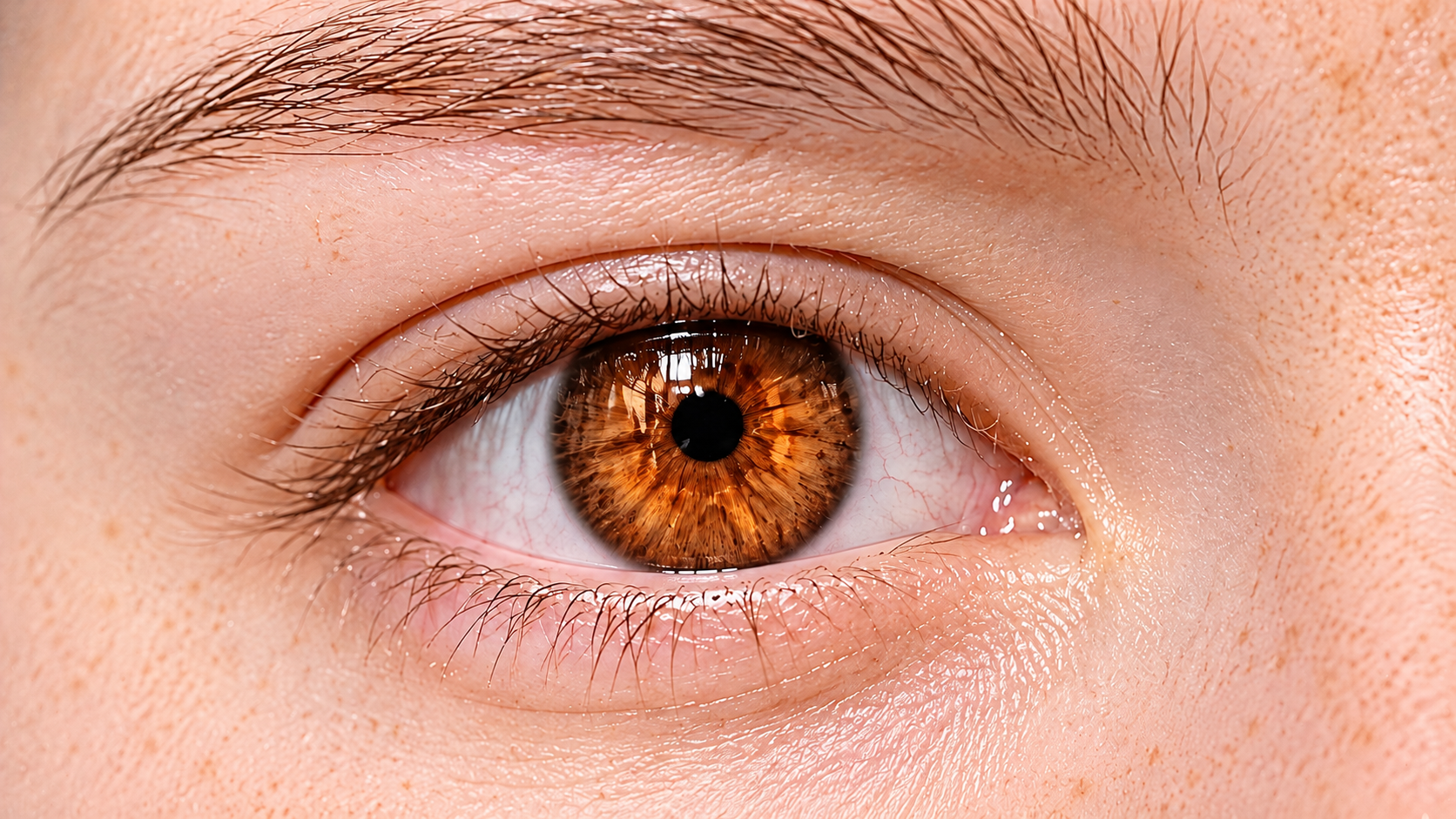
How rare are amber eyes? They are rarer than you might think, as only about 5% of people worldwide have this striking eye color. Brown eyes are the most common at 79%, while blue eyes appear in 8-10% of people and green eyes in just 2%. That solid gold, honey, or copper glow sets true amber eyes apart from hazel and light brown shades.
This piece explains what gives natural amber eyes their warm tone, how to distinguish amber brown eyes from gold brown or brown-and-gold eyes, and why genetics influence this color. You’ll also find safe options for trying cosplay contacts or amber colored contacts if you want to achieve the look yourself.
Are Amber Eyes Really Found in 5% of People?
That 5% figure appears on nearly every site that covers this topic, but the research tells a different story. Scientists have not conducted the large population studies needed to establish eye color prevalence with confidence, so the commonly cited number serves more as a rough placeholder than a verified statistic.
Where the common rarity estimate falls short
Estimates of amber eyes vary widely by source. Some place the figure at about 5% of the global population, while others describe it as "less than 5%". At least one source puts amber eyes at under 2% of people, or as low as 0.5%. This range exists in part because rarity changes by location, and some regions report much higher concentrations than others. Researchers need a unified global survey with consistent diagnostic criteria before any single percentage can be treated as more than an approximation.
Why eye color labels affect population counts
Researchers' eye-color categories also cause confusion. A large driver's license study of more than 235 million people in the United States grouped amber with pink, maroon, and dichromatic eyes under a catch-all "other" category that made up just 3.3% of the total. Self-reported color on a license form leaves room for error, and classification gaps often place amber in hazel counts or dismiss it as data noise. An ophthalmologist must use slit-lamp biomicroscopy to distinguish the two. The exam checks whether pigment is spread evenly across the iris or divided into the segmented zones typical of hazel. Most population surveys do not include that level of detail, so amber's true prevalence is likely underreported.
Why amber eyes are not tied to one nationality
No single ethnic group or country owns this eye color. Amber appears most often in people of Spanish, South American, South African, and Asian descent, while other accounts also identify East Asian, European, Middle Eastern, and Latin American populations. Notable concentrations also appear in Eastern Europe, especially Hungary and Romania, as well as among Central Asian populations in Kazakhstan and Kyrgyzstan. Additional reports trace amber eyes to Pakistan, the Balkans, Southern France, the Iberian Peninsula, Italy, Colombia, and the Southern Cone region. Genetics rather than geography alone determines who develops this golden hue, so it appears across continents instead of within one bloodline.
How to Tell Whether You Have Amber Eyes
Figuring out your actual eye color takes more than a quick look in the bathroom mirror. A few visual checks can help you tell whether you have genuine amber eyes or a color that only resembles amber.
Look for mainly honey, gold, or copper tones
Real amber eyes have one solid, even color that extends from the pupil to the outer rim. People often describe the shade as honey, golden amber, copper, yellow-gold, or light bronze. Lipochrome, also known as pheomelanin, creates this pigmentation. The same compound produces yellow and orange shades in leaves and flowers. Genuine amber eyes rarely contain green, blue, or gray flecks throughout the iris.
Check for green and brown zones that suggest hazel
Hazel eyes blend two or more color families. They often have a brown or gold center with a green outer ring. Your eyes are more likely hazel than amber if the iris appears green in some light and brown in others, or if it has clear color zones instead of one even shade.
Compare amber brown eyes with light brown eyes
Light brown eyes remain brown throughout the iris and have a clear brown base with few golden flecks. Amber brown eyes have a noticeable gold or copper cast, even when some brown shows beneath it.
Use indirect daylight without filters
Indirect daylight from a north-facing window on an overcast day offers the clearest view. It shows the full visible spectrum without magnifying warm or cool color casts. Direct sunlight can create glare and wash out the subtle differences you need to see.
Why photos and eye color apps cannot give a certain answer
Phone cameras use automatic white balance to correct color casts, and that can hide the details you need to examine. Close-up iris photos and eye-color apps often give inconsistent or conflicting results for the same eyes.
Why Do Natural Amber Eyes Develop?
Golden irises result from biology, not chance alone. The iris contains three pigment types, and amber eyes develop when melanocytes package high levels of pheomelanin, also called lipochrome, with very little eumelanin. Eumelanin is the dark brown-black pigment common in typical brown eyes. Blue and green pigments do not exist in the iris. Those colors result from light scattering through a stroma with low melanin, whereas amber reflects the pigment's physical color rather than an optical effect.
How several genes shape a child's eye color
Scientists once described eye color as a simple single-gene trait, but at least eight genes help explain differences in pigment concentration between people. Some studies place the number closer to 16 genes. A genome-wide study of nearly 193,000 people found more than 120 genetic associations linked to eye color. OCA2 accounts for about three-fourths of the blue-brown spectrum. Still, 7.5% of people with brown-eyed OCA2 alleles have blue eyes, which shows how unpredictable these gene combinations can be.
Why lighting effects are not the same as pigment changes
Clothing, pupil size, and ambient light may make eyes appear lighter or darker without changing the underlying pigment. Long-term sun exposure can darken eyes over time, however. That is a biological change rather than a temporary illusion.
Why eye color does not reveal personality
Folklore connects amber eyes with intuition or mystical traits, but scientific consensus considers these links unproven. Such beliefs reflect social perception more than genetics.
Can You Get Amber Eyes Safely?
Wanting a golden eye color is understandable, but the method you choose can affect your eye health.
Choose amber eye colored contacts with an eye care professional
Amber colored contacts are the only option ophthalmologists endorse to change eye color, but an eye care professional must fit them first. Federal law has banned the sale of contact lenses without a prescription in the U.S. since 2005 because it classifies every lens as a medical device. Skipping a professional fitting can cause serious problems. A Texas survey found that 60% of women who wore non-prescription lenses reported pain, redness, or swelling. That number rose to 88% among women who borrowed lenses from someone else.
Cosplay contacts also need proper fitting and hygiene
Cosplay contacts require the same prescription and fitting process, along with careful hygiene between scenes. Soak new lenses in fresh solution for six to eight hours before using them for the first time. Wash your hands before handling them, and remove the lenses as soon as you notice dryness or irritation. About 1 in 7 teens already use cosmetic lenses, and most admit to unsafe practices, such as storing them in tap water.
Drops and cosmetic eye-color procedures are not safe shortcuts
No FDA-approved eye drop can change iris pigment. Iris implants and keratopigmentation can cause uveitis or glaucoma and may lead to permanent vision loss.
Conclusion
Genuine amber eyes come from a distinct mix of pigment and genetics, not just a glance in the mirror. Natural light offers the most accurate way to check your iris tone. Whether you're curious about your own eye color or thinking about colored contacts, safety should of course guide your choice. Consult an eye care professional first, then enjoy that golden glow without risking your vision.